

Why Couples Feel Disconnected Even When They’re Together
There’s a quiet kind of disconnection that shows up in a lot of marriages.
No big fight.
No slammed doors.
No dramatic crisis.
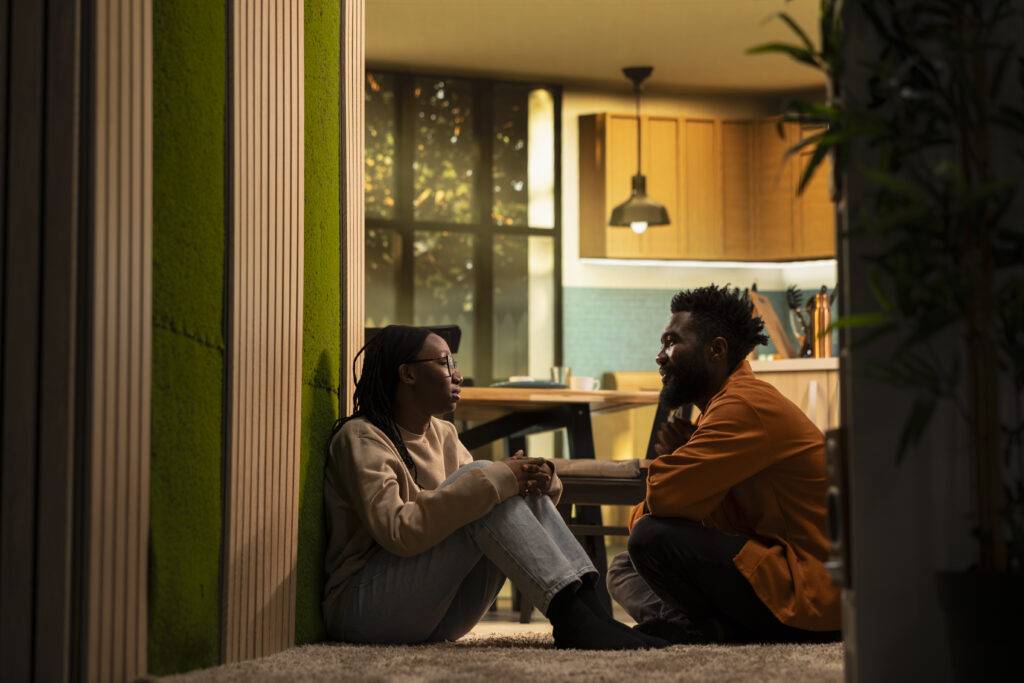
You’re in the same room. Maybe even on the same couch. One of you is scrolling. The other is watching something. You’re technically together, but it doesn’t feel like connection.
It feels more like coexistence.
And somewhere under the surface, one or both of you starts wondering:
Why do we feel disconnected even when we’re together?
That’s an important question. Because many couples assume that if they’re not actively fighting, things must be basically okay.
But peace and connection are not the same thing.
You can remove conflict and still have a marriage that feels flat, thin, and quietly lonely.
In a lot of cases, what’s happened is this:
You’ve unintentionally replaced connection with coexistence.
That’s one reason so many couples end up feeling like married roommates. They still share a house.
They still share responsibilities. They still sleep in the same bed and manage the same life.
But the deeper sense of us has started to thin out.

The idea of parallel intimacy, and why it appeals to people
There’s a growing conversation around what some call parallel intimacy. Some people use the phrase parallel play in a similar way: two people being near each other, each doing their own thing, without needing constant interaction.
There’s truth in that.
Healthy couples don’t need to be talking every minute to feel close. They don’t need to squeeze meaning out of every moment. They don’t need to give up independence in order to prove love.
In fact, forced togetherness usually backfires. It creates pressure. It makes things feel heavy and performative. It can make people feel trapped rather than connected.
So yes, parallel space can absolutely be part of a strong marriage.
But here is where couples get confused.
A lot of people are not practicing parallel intimacy.
They’re actually practicing parallel avoidance.
And those two things are not the same.
Being near each other is not the same as building the relationship
I sit with couples all the time who tell me they spend plenty of time together.
They eat dinner together. They watch shows together. They’re in the same space most evenings.
But when you look a little closer, something becomes clear.
There isn’t much real engagement happening.
Not much curiosity.
Not much emotional presence.
Not much intentional connection.
Not much that’s actually strengthening the “We.”
They’re not building anything in those moments. They’re just not fighting.
That matters.
Because your marriage is not static. It’s a living system. And whether you realize it or not, that system is always producing something.
More warmth or more neutrality.
More trust or more guardedness.
More closeness or more distance.
So when a couple says, “We feel disconnected even when we’re together,” I’m not just thinking about how many hours they spend in the same room.
I’m asking a better question:
What is that time actually producing between you?
Because proximity by itself does not build connection.
Shared air does not build connection.
Shared furniture does not build connection.
Intentional engagement does.
You can sit next to each other for three hours and strengthen nothing.
Or you can have twenty minutes of real presence, real warmth, and real contact, and lay another brick of trust in the relationship.
Small moments become the emotional memory of the marriage.
That’s why this matters so much.
Independence is not the enemy
Let me be clear.
Independence is not the problem.
Healthy marriages make room for individuality. You need space to think, breathe, decompress, and be a full person. That’s not selfish. That’s maturity.
The issue is not whether you have separate space.
The issue is whether that space is happening inside a relationship that still feels connected, responsive, and alive.
In strong marriages, independence and connection support each other.
In struggling marriages, independence often becomes a cover for disengagement.
It shows up in familiar ways:
Conversations become mostly logistical.
Bids for connection happen less often.
Screens become the default.
Curiosity fades.
Shared attention fades.
Nobody usually says, “I’m checking out now.”
It just becomes the pattern.
And the system starts producing distance.

Parallel time only works when connection is already healthy
This is where a lot of surface-level advice misses the point.
The same behavior can mean very different things in different marriages.
Two people sitting side by side doing their own thing can be a sign of comfort, ease, and security.
Or it can be a sign of disconnection, avoidance, and relational drift.
The activity is not the issue.
The underlying health of the relationship is.
Parallel space works best when it is resting on top of something solid:
There is emotional engagement.
There is repair when things get off track.
There is responsiveness.
There is a sense of being seen, known, and chosen.
There is a living sense of “We.”
In that kind of marriage, separate activity in the same space can feel peaceful and secure.
But when the relationship is already strained, that same pattern often reinforces the problem.
What looks harmless on the surface starts quietly feeding distance underneath.
Couples often drift into low-risk relating
Another related avoidant pattern I see all the time is what I’d call low-risk relating.
Couples stop engaging in ways that require too much.
Too much honesty.
Too much vulnerability.
Too much emotional exposure.
Too much possibility of friction.
So they keep things safer.
They talk about schedules.
Kids.
Tasks.
Bills.
Shows.
Travel plans.
What needs to get done next.
And yes, some of that is normal. Real marriages have logistics.
But when logistics become the main form of connection, the relationship starts to thin out.
The marriage becomes functional, but not deeply connected.
That’s often how drift happens.
Not through one giant blowup, but through a long stretch of low-risk relating.
A lot of marriages don’t explode. They slowly get bleached of color.
Everything stays manageable.
Everything stays civilized.
Everything stays fairly calm.
But not much is getting built.
Polite is not the same thing as intimate. Safe can quietly become sterile.
Why risk matters in real connection
Here’s one way I explain that to couples.
Sometimes I ask people if they remember any radio personalities, newspaper columnists, or news voices from years ago.
Usually they stop and think for a moment and then say something like, “Oh yeah, I remember so-and-so,” or “I remember my dad listening to Rush Limbaugh on the radio.”
Then I ask a second question.
Can you name the person who gave the traffic report this week? Or the weather report? Or the person on the radio you’ve heard almost every day on the drive home lately?
Usually they can’t.
And that’s interesting, because both people gave you information. Both reported the news. Both showed up in your life in some way.
So why do you remember one and not the other?
Because one was mostly just giving you the facts.
The other was giving you something more personal.
They told you what they thought.
They told you what they felt.
They revealed perspective.
They took a risk.
That’s what made them memorable.
It wasn’t about whether you agreed with them. It’s that they were not neutral. They were not trying to be forgettable. They risked friction. And because of that, people remembered them.
And that’s part of what makes relationships feel alive too.
When all a couple does is exchange facts, updates, and logistics, they may be communicating, but they are not necessarily letting each other know them.
True connection requires a higher level of risk.
It requires telling someone what you actually think.
What you actually feel.
What matters to you.
What scares you.
What you are carrying.
What you long for.
And yes, that creates the possibility of discomfort.
The other person may not like it. They may disagree. It may stir conflict.
But conflict is not always the enemy.
Handled well, conflict creates the opportunity for deeper honesty, deeper understanding, and deeper connection.
Avoiding conflict for fear of discomfort almost always guarantees something else instead.
You drift into parallel lives.
And if that goes on long enough, eventually the paths diverge.
A better question to ask
A lot of couples want to know:
“Is it okay that we spend time doing our own thing?”
That’s not the most helpful question.
A better question is this:
What is our current pattern producing between us?
That question moves you out of defensiveness and into discernment.
It shifts the conversation from, “Am I allowed to do this?” to, “What is this creating in our marriage?”
That’s where clarity starts.
Because two couples can do the exact same thing and get very different outcomes.
One couple feels peaceful, secure, and connected.
Another couple feels lonely, unseen, and miles apart.
Same couch.
Same room.
Same behavior.
Different system.
Different meaning.
Different result.
Have you replaced connection with coexistence?
Most couples don’t need to eliminate independence.
They don’t need to become glued together.
They don’t need to force interaction every minute of the evening.
But they do need to get honest.
Have we unintentionally replaced connection with coexistence?
Have we settled into patterns that feel easy but don’t actually strengthen the marriage?
Are we still building the “We,” or have we simply gotten better at living next to each other without asking too much?
Have we become partners, or have we quietly slipped into being married roommates?
Those are not condemning questions.
They’re clarifying questions.
And sometimes that clarity is exactly what a couple needs.
Before you move on, ask yourself this
Is parallel play really what our marriage needs right now, or is that just the more comfortable label for distance?
Are we enjoying healthy space inside a connected relationship?
Or are we playing it safe by living alongside each other instead of taking the risk to connect more deeply?
Are we building something together?
Or are we simply getting better at avoiding discomfort while the relationship thins out underneath us?
Because many couples don’t need more time in the same room.
They need more honesty, more courage, more intentionality, and more real contact inside the time they already have.
Final thoughts on feeling disconnected even when you’re together
If you’ve found yourself thinking, “We feel disconnected even when we’re together,” that doesn’t automatically mean your marriage is broken.
But it usually does mean something important is being neglected.
Usually not in a dramatic way.
In a gradual way.
A slow shift from engaging to coexisting.
From building to maintaining.
From choosing to defaulting.
And those shifts compound.
Parallel intimacy can absolutely be part of a healthy marriage.
But only when it is resting on top of real connection.
When it becomes a substitute for connection, it stops being intimacy and starts becoming a more comfortable form of distance.
If you need help thinking through those questions, a Marriage Review and Roadmapping Session is designed to do exactly that.
Not to fix everything in one sitting.
But to help you step back, see the system more clearly, understand what your current patterns are producing, and figure out what it would look like to start building connection again on purpose.